

Share
 Abdulazeez Abubakar
2 weeks ago
Abdulazeez Abubakar
2 weeks ago
Overview
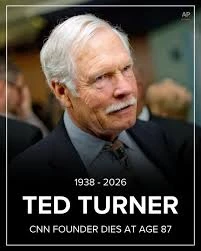
CNN founder Ted Turner, a pioneer of cable TV news, dies at 87
Ted Turner, the media maverick and philanthropist who founded CNN, a pioneering 24-hour network that revolutionized television news, died peacefully Wednesday, surrounded by his family, according to a news release from Turner Enterprises. He was 87.
The Ohio-born Atlanta businessman, nicknamed “The Mouth of the South” for his outspoken nature, built a media empire that encompassed cable’s first superstation and popular channels for movies and cartoons, plus professional sports teams like the Atlanta Braves.
Turner was also an internationally known yachtsman; a philanthropist who founded the United Nations Foundation; an activist who sought the worldwide elimination of nuclear weapons; and a conservationist who became one of the foremost landowners in the United States. He played a crucial role in reintroducing bison to the American west. He even created the Captain Planet cartoon to educate kids about the environment.
But it was his audacious vision to deliver news from around the world in real time, at all hours, that really made him famous – once his idea finally took off.
In 1991, Turner was named Time magazine’s Man of the Year for “influencing the dynamic of events and turning viewers in 150 countries into instant witnesses of history.”
Turner eventually sold his networks to Time Warner and later exited the business, but continued to express pride in CNN, calling it the “greatest achievement” of his life.
“Ted was an intensely involved and committed leader, intrepid, fearless and always willing to back a hunch and trust his own judgement,” Mark Thompson, Chairman and CEO of CNN Worldwide, said in a statement. “He was and always will be the presiding spirit of CNN. Ted is the giant on whose shoulders we stand, and we will all take a moment today to recognize him and his impact on our lives and the world.”
Just over a month before his 80th birthday in 2018, Turner revealed that he had Lewy body dementia, a progressive brain disorder. In early 2025, Turner was hospitalized with a mild case of pneumonia before recovering at a rehabilitation facility.
Turner is survived by his five children, 14 grandchildren, and two great-grandchildren.
Launching a TV news revolution
Turner began his media career at the age of 24 when he took over his father’s billboard company, Turner Outdoor Advertising, in the wake of the elder Turner’s suicide. He buried his shock and grief in work – but Turner wasn’t content to push other people’s products forever.
He bought up radio stations, then branched into television in 1970 by acquiring a struggling station in Atlanta known as Channel 17. He tried to boost the ratings by airing old sitcoms and classic films, at one point even hosting “Academy Award Theatre” himself.
Turner wasn’t interested in news yet. He decided to invest in sports instead, acquiring the rights to Atlanta Braves baseball games. Viewers and advertisers flocked to the channel, and as Turner turned a profit, he started to think bigger about TV.
In 1976 he beamed Channel 17’s signal up to a satellite and it became cable TV’s first superstation, reaching cable subscribers across the country.
Turner bought the Braves, and then the Atlanta Hawks basketball team, partly to keep the long-term rights to the TV programming, and partly because it was just plain fun.
As he built the Superstation WTBS, he set his sights even higher – a 24-hour news channel.
Turner was harshly critical of broadcast TV and establishment news judgments. “Part of the reason America had so many problems, he believed, was because his fellow Americans were so ill-informed,” former CNN journalist Lisa Napoli wrote in “Up All Night,” a book about the creation of CNN. Turner recognized “there was no better place to promote a variety of opinions than on allmighty television. With a news channel, he could quite possibly help save the world.”
A lot of people thought Turner’s idea was crazy. But he saw a huge opening in the marketplace.
“I worked until 7 o’clock, and when I got home the news was over,” he once said, referencing the 6:30 evening newscasts on the big networks. “So I missed television news completely. And I figured there were lots of people like me.”
Turner wanted to dramatically widen the aperture of television news, envisioning shows about business, health, sports and other subject matter. He admitted he knew “diddley-squat” about the news business, but he recruited the right people who did, like Reese Schonfeld, CNN’s founding president.
On June 1, 1980, CNN – the first 24-hour news channel – went live and has been on the air ever since.
Turner quickly expanded, adding a second 24-hour news network CNN2 (later renamed Headline News, then HLN) in 1982 and CNN International, which broadcast around the world, in 1985. He later added non-news cable channels including Turner Network Television (TNT), Turner Classic Movies (TCM) and the Cartoon Network.
In the mid-1980s, he acquired MGM’s library of more than 4,000 old films and stirred up controversy in the film community for colorizing many black-and-white movies, including “Casablanca.”
Out of all his networks, CNN was always his “baby,” but the network’s early years were marked by technical snafus during its long stretches of live broadcasting. Some critics dubbed it “Chicken Noodle News.”
Yet, Turner and his deputies knew they were creating something revolutionary.
“I lived for 20 years in my office,” Turner said. His office was inside CNN’s broadcast building in Atlanta. “I lived on a couch in my office the first 10 years.”
Longtime employees recall Turner sauntering into the newsroom wearing a bathrobe.
“He was one of us,” former CNN president Tom Johnson recalled. “He would be in his housecoat down having breakfast in the Hard News Café (the company’s cafeteria).”
When the Persian Gulf War broke out in 1990, the importance of a 24-hour news channel became clear. It was the first time a war was broadcast live – and it was only on CNN.
“What Ted made happen was just as important as the Internet revolution,” said former Turner Broadcasting CEO Terry McGuirk.
Turner was hailed as a visionary and earned TIME Magazine’s “Man of the Year” in 1991.
In 1996, Turner sold his networks to Time Warner for nearly $7.5 billion. He stayed on as a vice-chairman of Time Warner, heading up the company’s cable TV networks.
Shaped by family tragedies
Robert Edward Turner III was born in Cincinnati, Ohio, on November 19, 1938. At the age of 4, shortly after his sister’s birth, his parents sent young Ted to a boarding school, which he didn’t like.
“I wanted to be home,” he said.
Turner had a difficult relationship with his father, who had a weakness for alcohol and disciplined his son with a leather strap or a wire coat hanger.
“It wasn’t dangerous or anything like that,” Turner once recalled. “It just hurt like the devil.”
The family later moved to Savannah, Georgia, and his sister Mary Jean contracted a rare form of lupus when she was 12. The illness left her with brain damage and in severe pain for years until her death.
https://edition.cnn.com/2026/05/06/us/ted-turner-death